
Beyond the Blockchain Trilemma: Can Kaspa Scale at the Edge?
A critical analysis of node centralization risks, validation bottlenecks, and a potential backup scaling plan.

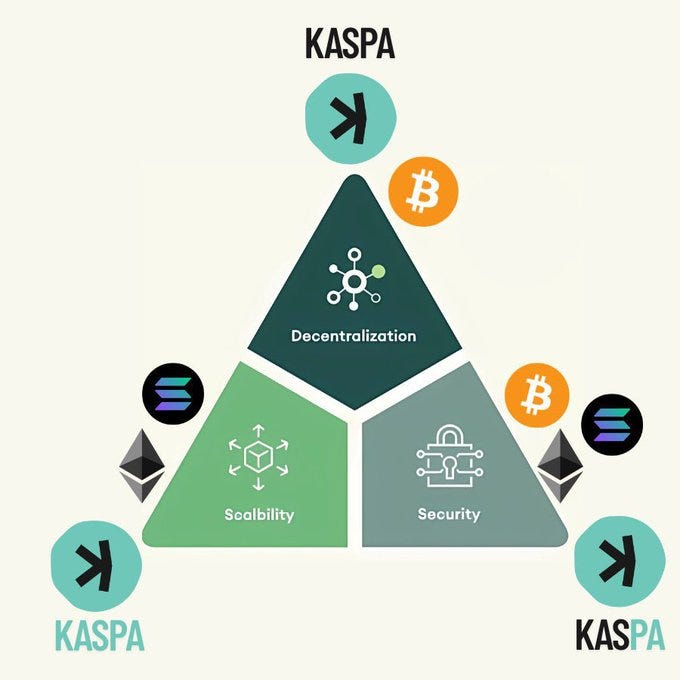
One of the most famous concepts in cryptocurrency is the Blockchain Trilemma, popularized by Ethereum co-founder Vitalik Buterin. The idea is simple: every blockchain must balance three competing goals:
Decentralization – Anyone can participate in validating the network.
Security – The network is resistant to attacks and manipulation.
Scalability – The network can process a large number of transactions efficiently.
The traditional view is that improving one area often comes at the expense of another. Bitcoin is generally considered highly decentralized and highly secure, but it sacrifices scalability. It processes relatively few transactions per second, and users can experience congestion and high fees during periods of heavy demand.
Ethereum historically made a similar tradeoff, prioritizing decentralization and security while struggling with scalability. Although Ethereum’s transition to Proof-of-Stake and Layer 2 solutions has increased throughput, critics argue that it has introduced new forms of centralization through staking providers, validators, and Layer 2 ecosystems.
Kaspa enters the conversation with a bold claim: perhaps the trilemma is not as rigid as everyone thinks.
Kaspa’s Thesis
Kaspa is a Proof-of-Work (PoW) cryptocurrency that uses a BlockDAG architecture rather than a traditional blockchain. Instead of forcing miners to compete for a single valid block at a time, Kaspa allows multiple blocks to coexist and be ordered efficiently.
The result is significantly higher throughput and much faster confirmations than traditional Nakamoto-style PoW systems. Supporters argue that Kaspa demonstrates something previously thought impossible:
PoW security
Permissionless participation
High throughput
Fast confirmations
All at the same time.
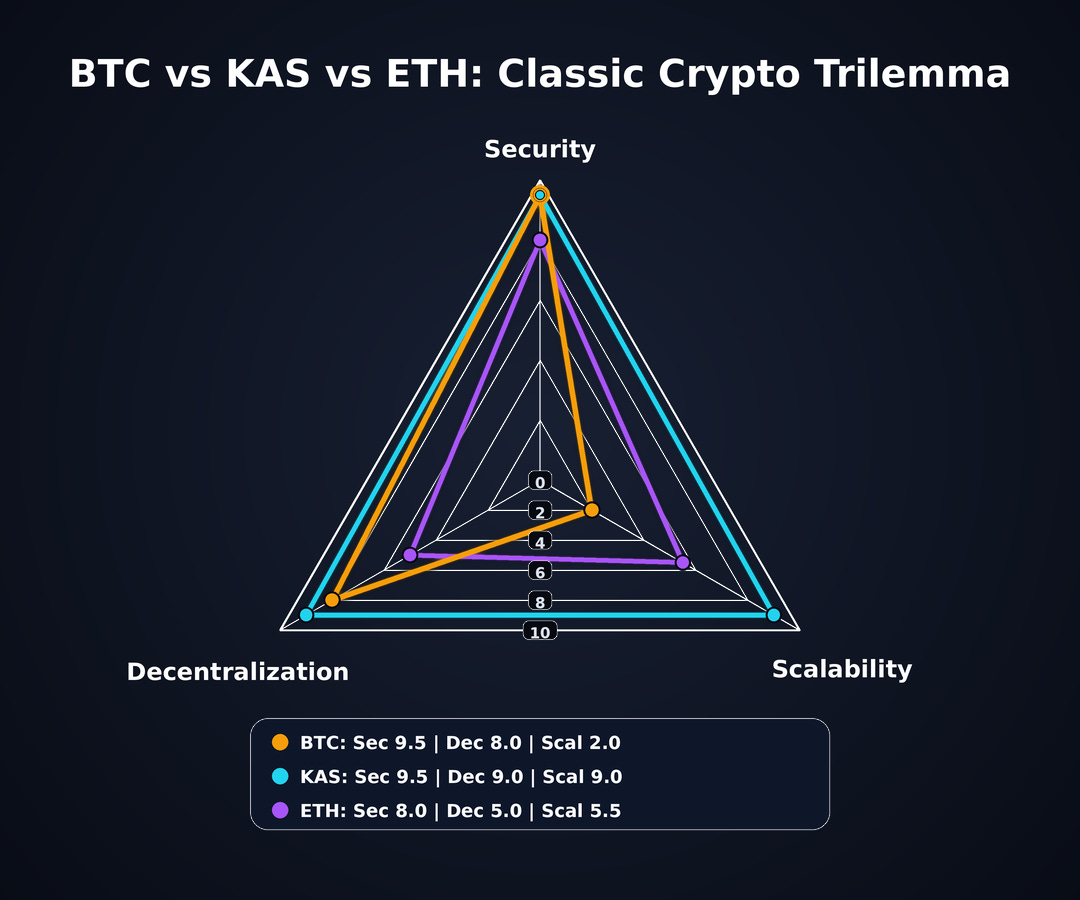
Note: The radar chart above is for illustrative purposes only. While the score metrics are abstract rather than mathematically derived, the chart remains directionally true to the core trade-offs of the classic trilemma. It highlights the structural tension Kaspa aims to break: achieving extreme Layer 1 scalability while maintaining a high security and decentralization baseline relative to its peers.
Kaspa demonstrates that significantly higher throughput and faster confirmations can be achieved within a Nakamoto-style PoW framework. However, critics argue that the story is not that simple.
The Main Criticism: Hardware Requirements
Scalability is one of Kaspa's strongest features while retaining a PoW security model based on generalized Nakamoto Consensus, an extension of the Nakamoto-style PoW approach pioneered by Bitcoin. This means Kaspa retains many of the security assumptions that have contributed to Bitcoin's resilience. The criticism usually targets decentralization, and the argument usually goes something like this:
As throughput increases, so do the computational requirements needed to validate the network. More transactions mean more:
Bandwidth
Storage
CPU resources
Memory requirements
Network synchronization demands
Even if mining remains permissionless, critics argue that running a fully validating node could become increasingly expensive. The concern is not whether Kaspa is decentralized today. The concern is whether it remains decentralized after years of throughput increases and protocol upgrades.
A network can be decentralized in its early years and gradually become less decentralized if the hardware and capital requirements needed to participate continue to rise. Bitcoin arguably illustrates this dynamic: mining has become so competitive that most participants must join pools to earn predictable rewards, resulting in a large share of the network's hash rate being coordinated through a relatively small number of mining pools.
Kaspa’s block rate and reward structure currently make solo mining more accessible at lower hash rates, but critics question whether that advantage can persist indefinitely as the network grows. Currently, the vast majority of miners are either unaware of this advantage or simply unwilling to solo mine. As a result, Kaspa suffers from the exact same hash rate pool centralization risks seen in Bitcoin and virtually all other PoW networks, where merely the top 2-3 mining pools control > 51%.

If validating the network eventually requires increasingly expensive or specialized hardware, then fewer individuals can participate directly, and validation becomes concentrated among larger operators. This is the strongest trilemma-based criticism of Kaspa, but also Kaspa's developers are keenly aware of this concern, and maintaining accessibility on consumer-grade hardware has been a recurring design goal discussed by them.
The Scalability Frontier vs. Everyday Hardware
Bitcoin’s relatively low throughput is often criticized, but one advantage of that design is that a full node can run on modest hardware. A college student, hobbyist, or retiree can participate in validation without requiring a data center. That accessibility contributes to Bitcoin’s decentralization. Kaspa intentionally pushes the scalability frontier much further, but the question critics ask is:
How far can that frontier be pushed before node requirements become a practical barrier?

Nobody knows the answer yet. Kaspa is still relatively young compared to Bitcoin. The real test will come as adoption, transaction volume, and network throughput continue to grow. The reason it remains an "unknown" open question isn't because the math is a mystery. It is because the math depends entirely on human variables: how cheap, efficient, and powerful consumer hardware becomes in the future, and how aggressively the core developers push the network's targets.
The Counterargument
The critics are assuming hardware remains static, but historically, hardware improves continuously. Bandwidth becomes cheaper. Storage becomes larger and less expensive. CPUs become faster. Memory becomes more abundant. Network infrastructure improves. In other words, because node requirements continuously expand alongside network growth, the real question is:
“Do node requirements increase faster than hardware improves?”

If consumer hardware improves faster than Kaspa’s resource requirements, then decentralization may remain largely intact. A laptop that struggles today may be considered low-end in five years. A storage requirement that seems large today may be trivial a decade from now. Supporters argue that Kaspa’s architecture was designed specifically with this reality in mind. Critics respond that hardware improvements are not guaranteed to outpace future throughput goals indefinitely.
Both sides have reasonable arguments, but the developers themselves have some influence over which outcome ultimately occurs.
The Human Consensus Factor
There is another variable that often gets overlooked. Technology alone does not determine outcomes. People do. Kaspa’s future depends heavily on a delicate, three-way coordination game played by its developers, node operators, and miners.
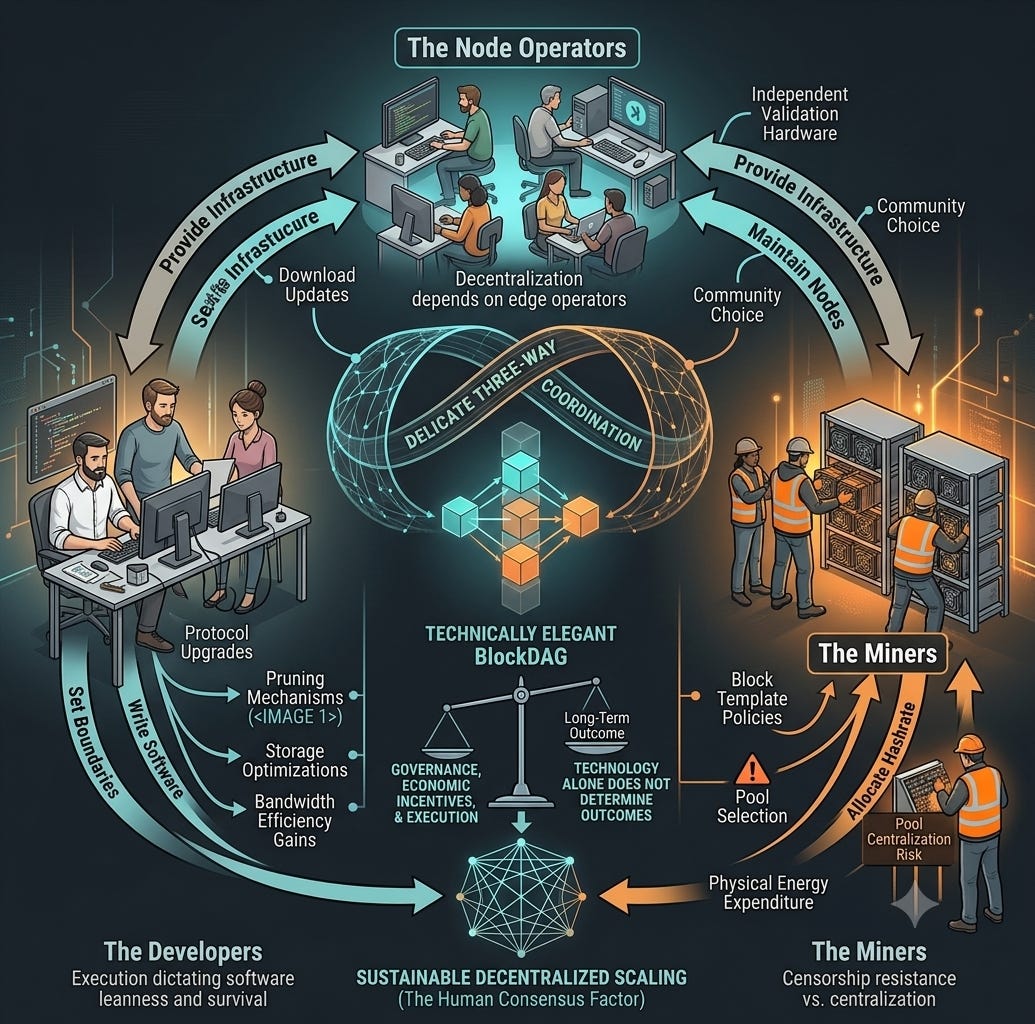
The Developers write the underlying software and set the theoretical boundaries. Their execution dictates whether protocol upgrades, pruning mechanisms, storage optimizations, and bandwidth efficiency gains can keep the code lean enough to survive higher throughput targets.
The Node Operators provide the actual infrastructure of the network. Because they run independent validation hardware entirely on their own dime, their willingness to download updates and maintain full nodes determines whether the system remains decentralized or consolidates into a handful of commercial data centers.
The Miners secure the ledger by expending physical energy. The block template policies they enforce, the mining pools they choose to support or break away from, and how they allocate their hash rate dictate whether the base layer remains censorship-resistant or succumbs to centralization.
A technically elegant design can still fail if development choices are poor or if the community refuses to run the infrastructure. Conversely, a design with steep theoretical resource demands can remain remarkably healthy if engineering decisions are prudent and the ecosystem remains fiercely committed to keeping validation accessible at the edge. This means the long-term outcome is not solely determined by BlockDAG technology itself. It is ultimately determined by governance, economic incentives, and execution.
So What Does Kaspa Actually Trade Off?
Today, Kaspa appears to achieve significantly higher scalability while retaining Nakamoto-derived PoW security all without an obvious or immediate sacrifice in decentralization. The traditional trilemma tradeoff is not necessarily eliminated, but rather dramatically reduced. The real question is whether that remains true as the network grows.
If hardware and software efficiency outpace Kaspa’s resource requirements continuously, the tradeoff may remain negligible. If they do not, then decentralization could eventually come under pressure and become the obvious sacrifice if no alternative fixes can be found.
Critics argue that the tradeoff still exists and may become apparent over time, but neither side has definitively won that argument just yet.

Three Likely Outcomes
1. Kaspa Eventually Hits the Decentralization Wall
In this scenario, node requirements grow faster than consumer hardware capabilities. Running a full node becomes increasingly difficult for ordinary users. Validation becomes concentrated among larger operators. The traditional trilemma reasserts itself, and Kaspa ultimately sacrifices some decentralization in exchange for scalability.
2. Kaspa Stays Ahead of the Hardware Curve
In this scenario, hardware improvements, protocol optimizations, and engineering advances consistently outpace network demands. Ordinary users remain capable of running full nodes. Kaspa maintains meaningful decentralization while continuing to scale. If this occurs, Kaspa becomes one of the strongest real-world challenges to the conventional understanding of the blockchain trilemma.
3. Something Nobody Anticipates Happens
Technology rarely follows a straight line. Unexpected technical challenges, economic shifts, security issues, regulatory developments, market dynamics, or entirely new technologies could alter the landscape. Kaspa could fail for reasons unrelated to the trilemma altogether. History is full of technically impressive projects that were ultimately overtaken by factors nobody predicted.
Layer 2 as a Back-Up Plan?
Kaspa’s most serious criticism is not that it sacrifices scalability or security. It is that future scalability may eventually pressure decentralization through increasing hardware and infrastructure requirements. Whether that concern becomes a practical reality remains unknown. The debate ultimately comes down to a simple question:
Can Kaspa’s architecture and development continue to stay ahead of the resource demands created by its own success?
Ethereum faced a similar scaling dilemma. To prevent its network from becoming too expensive and centralized for everyday users, Ethereum chose to restrict its base layer’s speed and offload its traffic to Layer 2 networks. Kaspa is taking the opposite gamble: trying to handle massive global scale natively on Layer 1 while relying on future hardware advancements and data-pruning techniques to keep the network decentralized. Interestingly, Kaspa can still support Layer 2 scaling almost as a backup plan, since it naturally functions as an incredibly efficient settlement layer if extra capacity is ever required.
In fact, traditional Layer 2 networks are already emerging on Kaspa, but they rely on standard rollup architectures. These designs are not intentionally parasitic, but they inherit the same data-availability bottlenecks and virtual machine burdens that inevitably tax the underlying host chain.
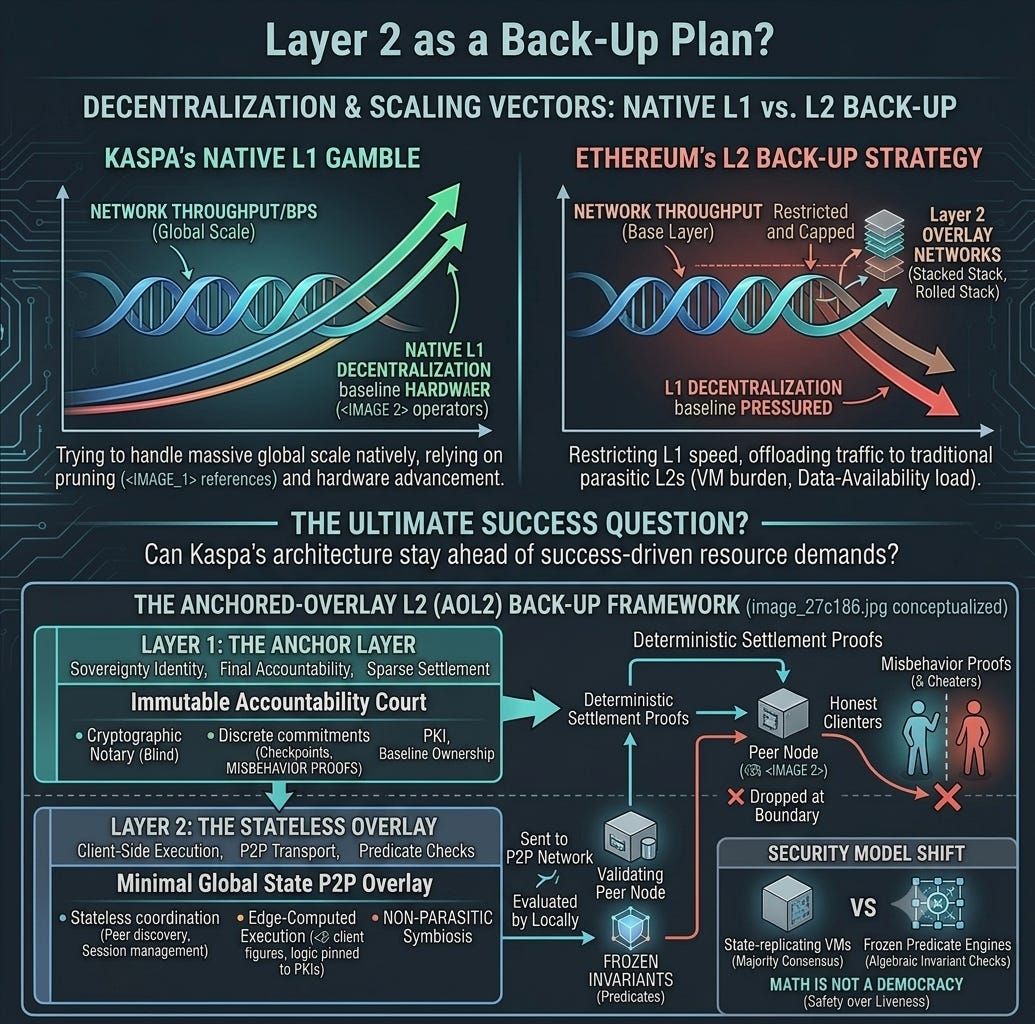
However, I believe Preserving Kaspa's native efficiency requires an entirely different approach to off-chain scaling: the Anchored-Overlay Layer 2 (AOL2) framework. Unlike traditional, data-heavy rollups, AOL2 shifts execution entirely to user hardware at the edge. By routing state transitions directly peer-to-peer and checking them locally, it unlocks massive scale without imposing a computational footprint on the base layer. This paradigm allows for global, open-access public sessions and lobbies while using Layer 1 strictly as an immutable cryptographic notary to anchor identity and record signed checkpoints. Because dispute resolution and peer blacklisting are handled entirely by client apps at the boundary, the system achieves true high-throughput scaling without placing an operational or computational tax on the base layer.
Final Thoughts
Will Kaspa prove that high-speed Proof-of-Work can scale without compromising its democratic roots, or will it eventually face the same centralization bottlenecks that have forced other chains to compromise? Even if faced with infrastructure strains, can architectures like AOL2 become a necessary frontier that preserves its decentralized roots? Is Kaspa the answer to the pool centralization risks plaguing PoW networks?
Only time will tell.

I don’t know who you are but you write concisely, and very well. Thank you for doing this.