
The Anchored-Overlay Layer 2 (AOL2)
A Stateless Overlay Paradigm for Client-Driven Execution with Sparse L1 Anchoring and Without Blockspace, Fee, or Security Budget Competition

The Anchored-Overlay Layer 2 (AOL2) is a stateless network paradigm that minimizes reliance on continuous global state replication. It shifts execution to the network edges (clients) while using L1 strictly as an immutable anchor for identity, accountability, and sparse event settlement.
Execution occurs locally on client hardware. Integrity is enforced through frozen, deterministic predicate evaluation at the boundaries. L1 serves as a cryptographic court of final resort rather than an active executor.
Architectural Division of Labor
┌─────────────────────────────────────────────────────────────────┐
│                    LAYER 1: THE ANCHOR LAYER                    │
│ • Sovereign Identity • Final Accountability • Sparse Settlement │
└────────────────────────────────┬────────────────────────────────┘
                                 │
                     ▲           │           ▼
           Deterministic         │         Identity /
           Settlement Proofs     │         Access Assurances
                                 │
┌────────────────────────────────┴────────────────────────────────┐
│                   LAYER 2: THE STATELESS OVERLAY                │
│ • Client-Side Execution   • P2P Transport   • Predicate Checks  │
└─────────────────────────────────────────────────────────────────┘
Layer 1 Provides: Identity, Accountability, & Event-Settlement
Immutable Accountability: L1 functions as a blind cryptographic notary. It anchors discrete commitments, such as batched checkpoint roots, finalized round hashes, or misbehavior proofs, rather than validating continuous execution traces.
Sybil Resistance & Identity: L1 manages public-key infrastructure (PKI) and baseline ownership. Misbehavior can be permanently recorded by anchoring fraud proofs that bind cheating public keys to verifiable violations. Note that while L1 anchoring raises the visibility and reputational cost of attacks, it does not prevent cheap key creation. Effective Sybil resistance requires application-level mechanisms (session entry costs, bonding, whitelists, or rate-limiting) layered on top of L1 identity.
Symbiotic Security: AOL2 posts to L1 only on checkpoints or disputes. It avoids running a parallel VM or imposing continuous data-availability and settlement load on L1. This makes it lighter than many traditional L2s, though it still inherits L1’s finality and security for anchored events. To be clear, it is not the first design with these properties as elements draw from client-side validation (e.g., RGB), state channels, and predicate-based systems.
Layer 2 Provides: Transport & Integrity (Stateless Overlay)
Minimal Global State: AOL2 eliminates a persistent shared L2 ledger, universal mempool, or centralized sequencer. There is no single protocol-level point for MEV extraction. However, practical deployments still require lightweight shared coordination such as peer discovery, gossip protocols, and session management. These mechanisms can introduce bottlenecks, eclipse attacks, and relay-based reordering or withholding risks.
Edge-Computed Execution: Participants run logic locally. State transitions are cryptographically pinned to participant public keys. All interactions must be validated against agreed predicates before acceptance.
Non-Parasitic: Because state transitions are processed locally and routed directly peer-to-peer, AOL2 avoids placing continuous computational or data-availability burden on the underlying blockchain. This enables high-throughput scaling for suitable applications while remaining symbiotic with L1.
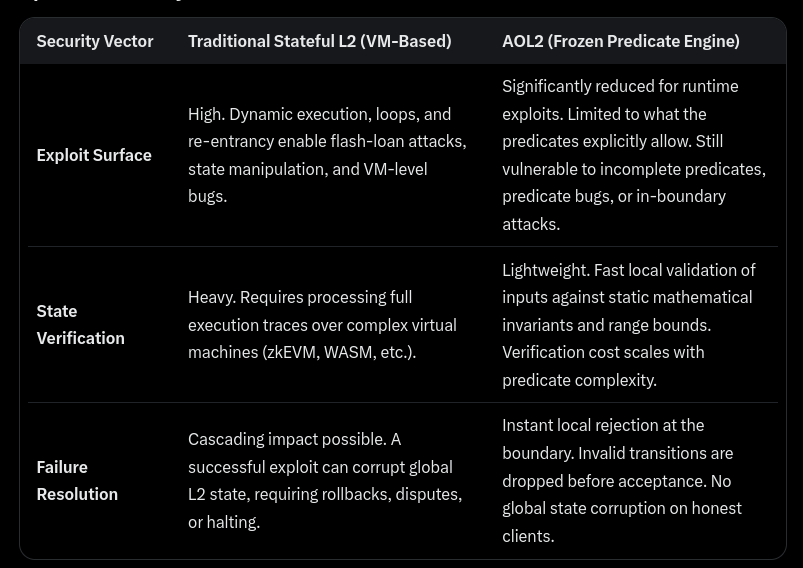
Security Profile: Stateful VMs vs. Frozen Predicate Engines
AOL2 shifts from dynamic virtual machine execution to static predicate validation. This changes the threat model significantly but comes with important trade-offs.
The Bitcoin Blueprint: Why Client Execution Isn’t Suicide
To an engineer accustomed to centralized servers or state-replicating virtual machines, pushing execution entirely to the client sounds like an open invitation to chaos. If the client runs the code natively, what stops a malicious peer from modifying their local binary to forge a transaction out of thin air?
The answer lies in the fundamental design of the Bitcoin network.
Bitcoin nodes do not rely on a central server to police what software other nodes are running. A Bitcoin node can modify its local source code to allow infinite inflation, skip signature checks, or double-spend. The node can run whatever malicious code it wants natively on its machine.
But it doesn’t matter.
The moment that rogue node broadcasts its state change to the rest of the network, the neighboring nodes validate the resulting p2p data broadcast against a set of frozen, immutable invariants (the consensus rules). If the transaction violates a single rule, the peers instantly drop the data at the boundary. The rogue node is simply ignored, isolated in its own broken reality, while the network moves on perfectly intact.
In those types of systems, Global Consensus is the only thing protecting the network. The validators act like a giant, centralized server room that forces everyone to process transactions in the exact same order, at the exact same time, to prevent cheating.
But AOL2 doesn’t use global consensus because it doesn’t need to prevent people from cheating inside their own apps. It prevents that cheating from infecting anyone else.
[Malicious Client] ──(Mutated Local Code)──► [Invalid Transaction Data]
                                                        │
                                             (Sent to P2P Network)
                                                        │
                                           ┌────────────▼────────────┐
                                           │   Validating Peer Node  │
                                           │  Evaluates Invariants   │
                                           └────────────┬────────────┘
                                                        │
                                           ❌ [Dropped at Boundary]
AOL2 Applies the Same Invariant Enforcement
AOL2 treats client execution exactly the same way. The stateless overlay network does not care if a user alters their local game client or financial routing binary. The user’s client can manipulate its local RAM all day long.
To settle an event or pass a state transition to a peer, the client must generate a cryptographic proof showing that the new data conforms to the frozen ruleset of the chained predicates.
The security of an AOL2 system does not come from policing the user’s CPU or trying to secure the execution loop. It comes from immediate peer‑to‑peer verification: the counterparty client checks the proof, and the L1 anchor enforces the algebraic boundaries of the output data. If the math violates static range bounds or invariant equations, the event is rejected instantly.
Important: QSSM enforces exactly what the predicates define. A cheat that falls outside the predicate model will not be caught. The completeness of the ruleset, encoding every rule the application requires, is the developer’s responsibility. The predicate engine is only as strong as the predicates written for it.
Cheat the client all you want, but you cannot cheat the boundary.
Math Is Not a Democracy (The Frozen Predicate Shield)
In traditional state-replicating blockchains (or standard BFT consensus networks), the rules are determined by majority consensus. If 51% of the validators agree a bad block is valid, the bad block becomes reality.
AOL2 flips this entirely. Validation is algebraic, not democratic.
When a corrupt majority of cheaters submits a forged state‑transition claim to an honest player, they can’t just send a collective vote saying “we win.” They must present a cryptographic proof containing the proposed next state Sn+1 that satisfies the rigid, chained predicates. If their modified client produces illegal movement speeds, forged item data, or incorrect balance updates, the math inside your local client’s frozen predicate engine fails immediately. Your client doesn’t ask for consensus; it sees the constraint violation and drops their data at the boundary. To your application, those malicious players simply disappear into an invalid, broken reality.
It’s important to distinguish safety from liveness. AOL2 guarantees safety: a malicious majority cannot force your client to accept an invalid state. It does not guarantee liveness: a malicious majority can halt a session by refusing to participate, withholding signatures, or going silent. They can ruin a match, but they cannot corrupt your state or forge a valid outcome. These are fundamentally different attacks with fundamentally different consequences, and AOL2 is designed to defeat the dangerous one.
The L1 Accountability Trap: Resolving the 51% Collusion Attack
Let’s take the nightmare scenario: A malicious majority of players (such as an automated AI botnet) occupies 3 out of 4 slots in a match. They decide to ignore you entirely. They cut your client out of the P2P transport group, sign a fraudulent outcome amongst themselves, and broadcast that garbage state checkpoint to Layer 1.
Because each participant’s identity (public key) is bound to the L1 anchor, they must sign the checkpoint root to participate at all. If they attempt to submit a forged checkpoint, they are literally signing their names onto a cryptographic lie.
Layer 1 is a blind ledger, not an active judge. The anchoring contract defines what counts as a valid checkpoint — whether that requires unanimous signatures, a threshold majority, or some other rule is entirely determined by the application’s anchoring policy. If the policy requires all signatures, this attack cannot occur. If it accepts a majority, L1 will record the majority’s signed entry. In both cases, the outcome is the same: the malicious participants have attached their identities to a provably false state. However, in AOL2, validation is local and handled at the edge by each client independently.
The Invariant Contradiction: Your local client notes that a state transition occurred without your valid signature, or detects a direct mathematical contradiction with the last mutually signed state snapshot (Sn).
Proof of Fraud: Your client generates a compact Cryptographic Misbehavior Proof using its local engine utilities. This proof identifies the exact algebraic invariant that the cheaters’ signed state root violated.
Edge‑Based Filtering: You publish this raw cryptographic proof to the public peer‑to‑peer overlay. Honest clients handle the rest: neighboring applications ingest the proof, evaluate the invariant failure locally, and independently add the malicious public keys to their routing blacklists. For permanent, globally accessible accountability, the proof can optionally be anchored to L1, creating an immutable on‑chain fraud record. P2P‑only publication is sufficient for active participants but does not persist for newcomers — L1 anchoring is recommended when a permanent, universally accessible fraud record is required.
The Hard Truth of the 51% Attack
A 51% attack by a malicious majority cannot corrupt your local game state, and it cannot force your client to accept a lie, because math is not a democracy.
While a corrupt majority can ruin an active match and halt active gameplay, they do so at the cost of immediate social and operational depreciation. When a malicious majority tries to bypass a boundary, they leave a permanent, signed cryptographic trail. The ecosystem responds automatically: honest clients ingest the misbehavior proof, verify the invariant failure locally, and blacklist or isolate the offending public keys at the edge.
Decentralized reputation, however, accumulates over time. A new participant joining after a fraud event has no local blacklist history and is initially vulnerable to the same malicious actors until they encounter and reject them organically, or until they bootstrap their reputation state from a trusted peer or an L1‑anchored fraud record. Application developers should plan for this by implementing reputation‑bootstrapping mechanisms — for example, querying L1‑anchored misbehavior proofs on first connection — rather than assuming newcomers inherit the network’s accumulated reputation automatically.
Summary: Why AOL2 Defies Traditional 51% Attacks
On the L2 Overlay: A corrupt majority can only gaslight themselves. Because your local client forces every incoming packet through a frozen, stateless validation check, a million cheaters cannot force your engine to accept an invalid state transition.
On the L1 Anchor: A corrupt majority can only commit structural identity suicide. By signing an invalid boundary transition, they generate an immutable fraud trace that allows the edge network to universally reject their keys.
Conclusion
AOL2 provides strong safety properties for well-specified applications: honest clients cannot be forced into invalid states, and malicious actors risk permanent, verifiable reputational damage through signed fraud traces. It reduces L1 load compared to always-on L2s and leverages the proven “cheat the client, but not the boundary” model inspired by Bitcoin.
In AOL2, you don’t need to trust the majority of the players. You only have to trust that the math cannot lie, and the ledger cannot be altered.