
25+ Striking Clues Linking Kaspa’s Creator to Bitcoin’s Mysterious Founder
There's a 99.9% chance Yonatan Sompolinsky is Satoshi Nakamoto
Update (4/22/2026): added #27 a possible connection with citation [2] in BTC whitepaper and Yonatan
How Many Coincidences Until Something Is No Longer a Coincidence?
Remember when Satoshi said they moved on to other things? What if they came back with what they had been working on? Would you recognize it or assume it was another shitcoin?
1. Yonatan Sompolinsky, along with his advisor Aviv Zohar, was the first to publish a rigorous security analysis of Bitcoin—at a time when only six academic papers had even attempted to tackle the subject.

2. Several major cryptocurrencies reference Yonatan’s work. For example, he created the GHOST protocol in 2013, which gained prominence after being cited in the Ethereum Whitepaper as a foundational design goal.


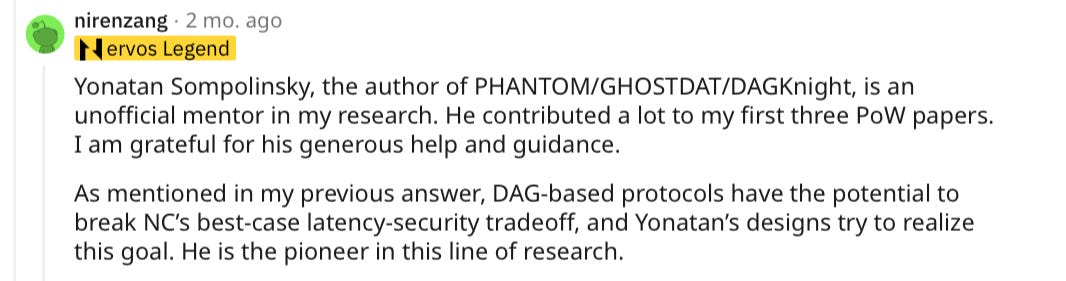
3. Yonatan coincidentally joined Twitter in the same month and year Satoshi disappeared.
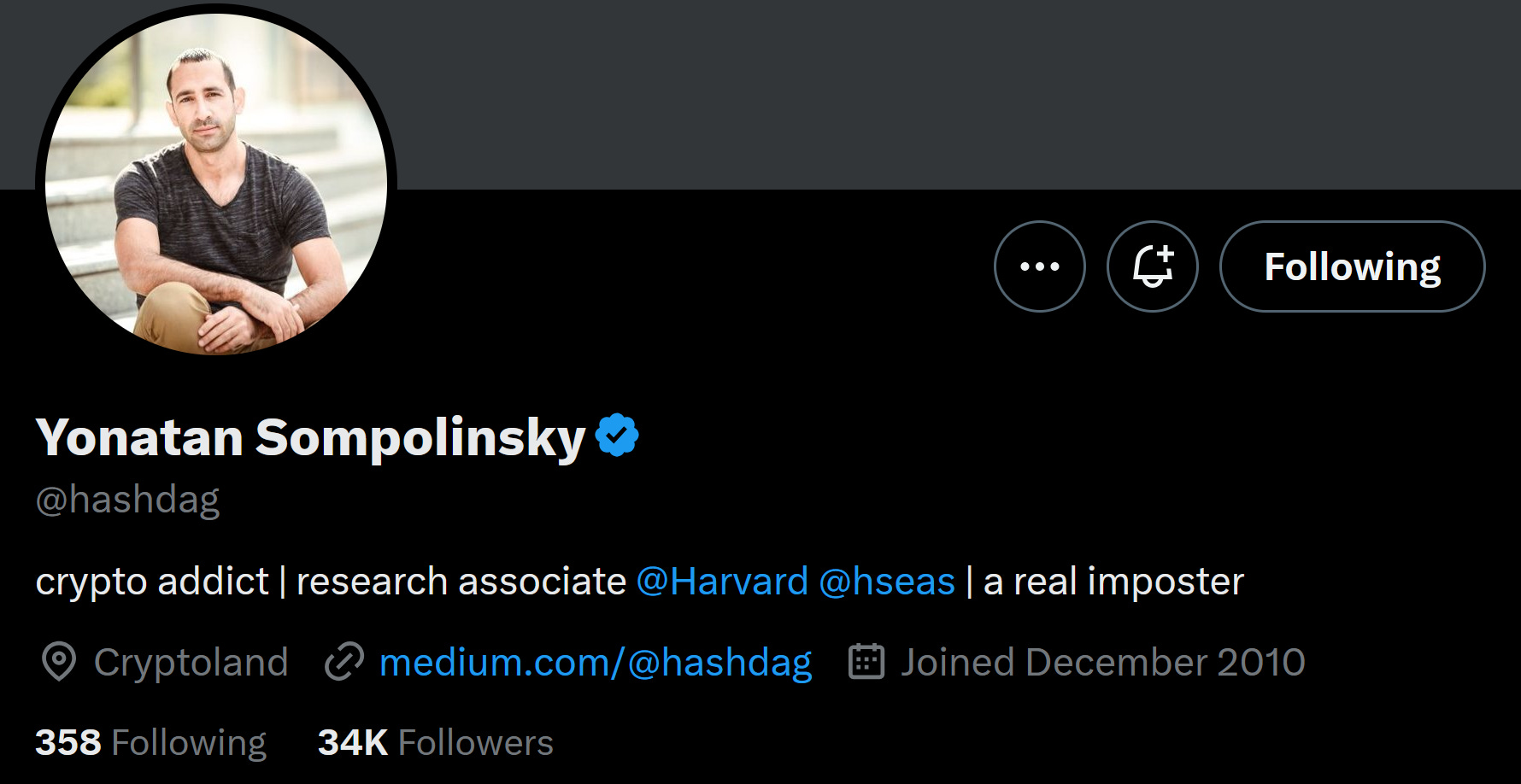
4. Yonatan’s Twitter profile reads “a real imposter” and in this twitter conversation, when asked, “Can we go with the real name in our mutual paper?” he replied, “You mean the real imposter name? Sadly, Satoshi’s…” That sure sounds like Yonatan is saying the name in his profile—“a real imposter”—refers to Satoshi.
The equation is another hint, as the only way to remove a co-author component is if there is no co-author because the author and alleged co-author are the same person.
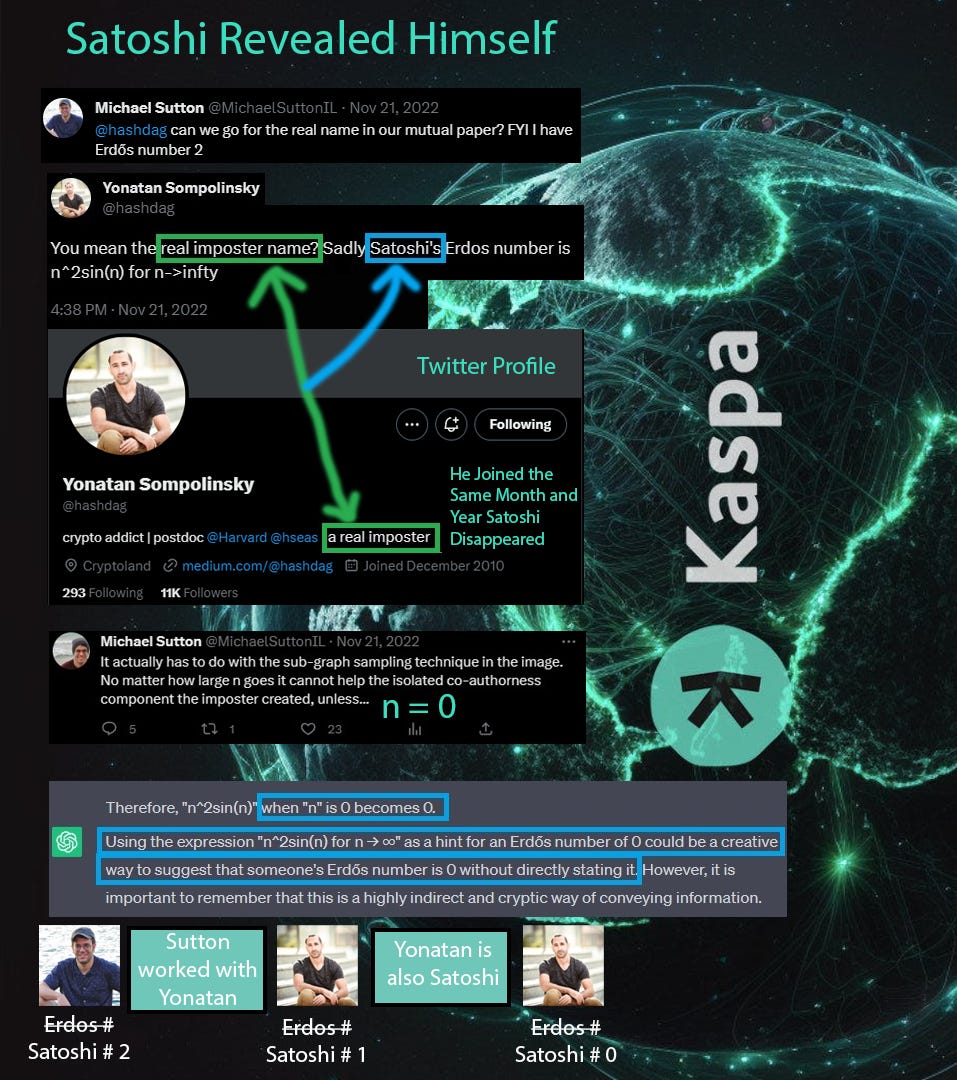
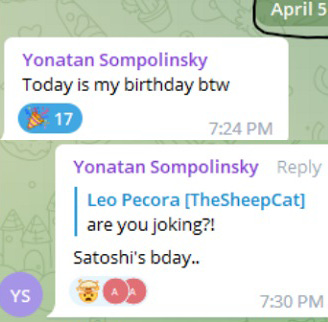
5. Yonatan’s birthday is the same as Satoshi’s.
6. Yonatan was previously suspected of being Satoshi by Aziz Elmir back in 2017.

7. Yonatan has been seen with a zCash mug and has even met with the founder. We also know that Satoshi directly communicated with the zCash founder via email.
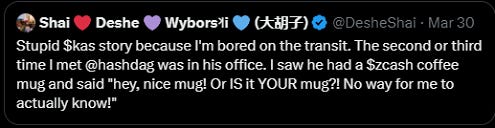
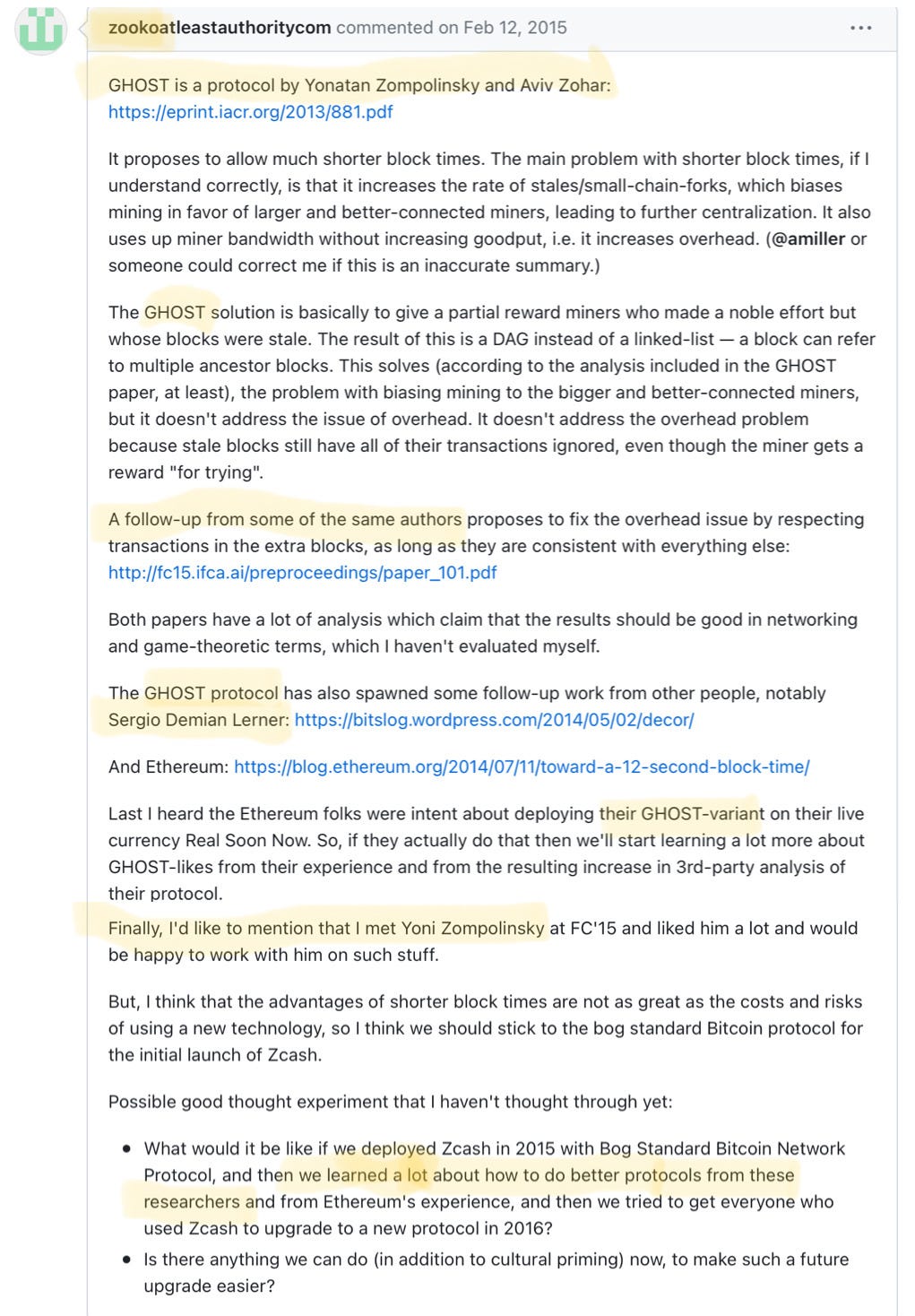

8. Yonatan is often described as a kind and humble person—much like Satoshi—despite Shai Wyborski’s unsuccessful attempts to discredit him. I’m not sure if Shai is just being theatrical to try to make it seem less likely or if he genuinely feels crossed by Yonatan.
9. Satoshi’s last message on p2p foundation posted 1 word “nour” which is Aramaic meaning to bring darkness to light. Kaspa is also Aramaic meaning silver/money. It is entirely possible this account was merely hacked, but why would the hacker simply add Wagner and post “nour” if that was the case?

10. Onnyy Satosi Lankmo is an anagram of Yonatan Sompolinsky. When you say “Onnyy” in Hebrew (אני) it means “I am”; Lankmo = לאנקמו meaning “to take revenge” OR “לנקמו” which means “to avenge him”.
“I am Satoshi to avenge him/to take revenge”
11. There are also 11 letters in “Yonatan Sompolinsky” and Kaspa launched on November, the 11th month. This alone isn’t much, but it is yet another “coincidence” in the ever growing list.
12. He cryptically admits he is Satoshi and non-cryptically.


13.
In this context, ‘she’ just means an unknown person, but the only way he could know Satoshi hasn’t been to conferences for years is if he went to conferences in the past with Satoshi or he is Satoshi and he hasn’t been to conferences in years. From what I gather, FC 2015 is the last conference he attended that wasn’t Kaspa related.
14.
“I Am Not Taking It Lightly to Build Another Coin” - Yonatan
He’s never made any other coins, except for Kaspa, as far as the public is aware…
15. Yonatan almost slips up and reveals himself in another interview. When he was so passionately talking and says:
Sounds to me like he was about to say “This was the original plan”. Meaning Kaspa was planned to beat Bitcoin before Bitcoin was even created.
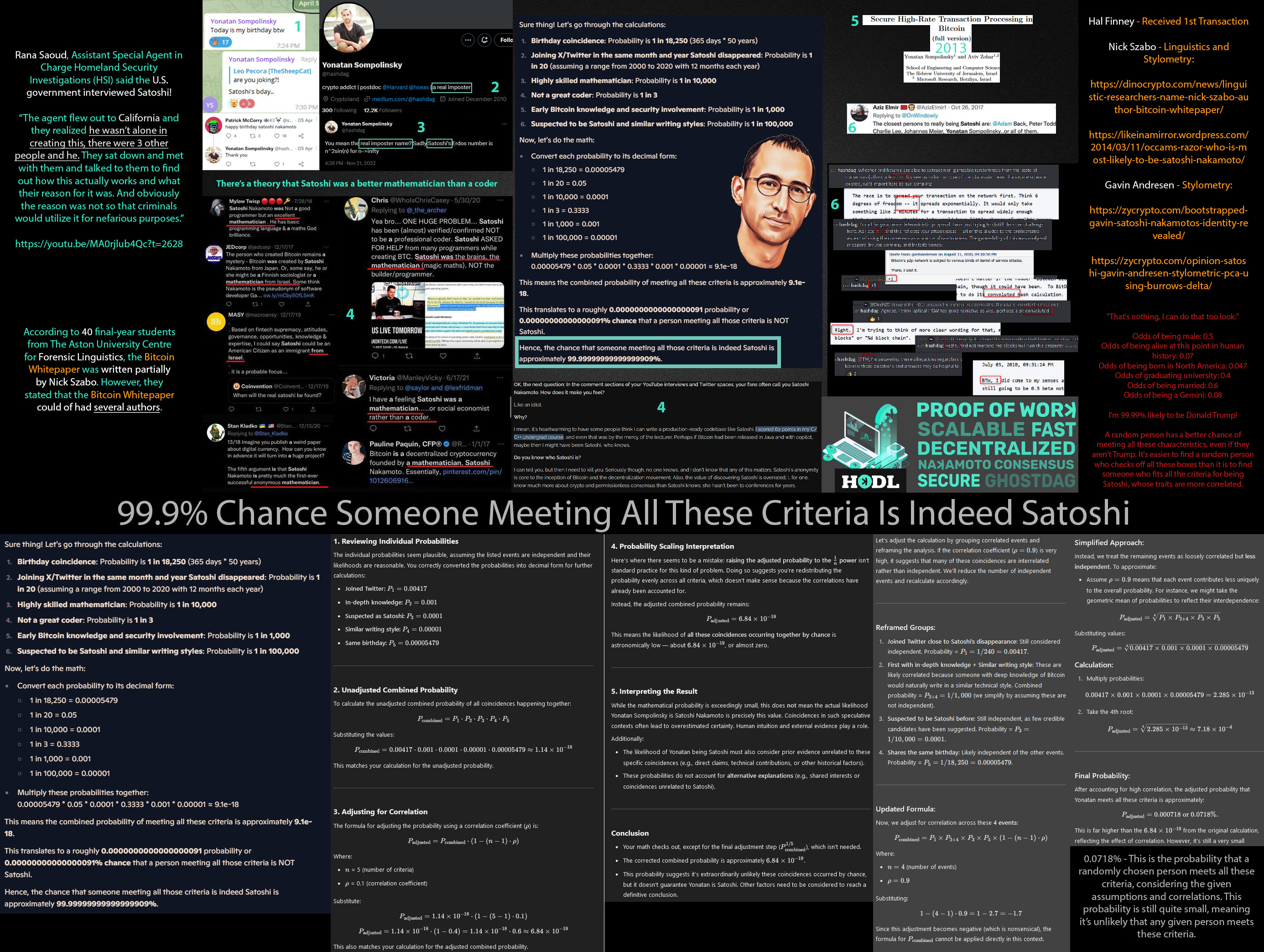
There’s a very high probability that Yonatan is Satoshi.
Birthday coincidence: Assuming an approximate average lifespan and considering many relevant years, the probability is quite small. Let’s say we consider 50 years; we then have a 1 in 18,250 (365 * 50) chance that someone shares the same birthday and year combination as Satoshi.
Joining X/Twitter in the same month and year Satoshi disappeared: Assuming a range from 2000 to 2020, with 12 months in a year, the chance would be around 1 in 20.
Highly skilled mathematician: Roughly 1 in 10,000 people are highly skilled mathematicians.
Not a great coder: An estimated 1 in 3 mathematicians are not great coders.
Early Bitcoin knowledge and security involvement: Around 1 in 1,000 tech-savvy individuals had early Bitcoin knowledge.
Suspected to be Satoshi and similar writing styles: A very niche group, let’s assume 1 in 100,000.
Multiplying these probabilities together comes to 9.1e-18 or 0.0000000000000000091, the resulting number is extraordinarily small. Hence, it’s extremely unlikely for someone to fit all these criteria without being Satoshi—but not impossible!
That means there is roughly a 99.99999999999999909% chance that someone meeting all these criteria is indeed Satoshi!
Arguing that those are independent? Adjusting for correlation doesn’t seem to have much difference (still a 99.9282% chance he is Satoshi)
“That’s nothing, I can do that too look:”
Odds of being male: 0.5
Odds of being alive at this point in human history: 0.07
Odds of being born in North America: 0.047
Odds of graduating university: 0.4
Odds of being married: 0.6
Odds of being a Gemini: 0.08
“I’m 99.99% likely to be Donald Trump”
A random person has a better chance of meeting all these characteristics, even if they aren’t Trump. It’s easier to find a random person who checks off all these boxes than it is to find someone who fits all the criteria for being Satoshi, whose traits are more correlated.
17. Kaspa has a bible verse inscribed in the first “block”. Satoshi was obviously the first to do this, and many other projects have also included a message in their first block.
However, this message just feels like it’s part 2, to me at least. Seems like Satoshi had this plan all along, first create a place to securely store our money and replace the banks, and then a way to securely use the money daily.
Bitcoin’s:
“The Times 03/Jan/2009 Chancellor on brink of second bailout for banks”
Kaspa’s:
“Whatever seems good to you and your brothers to do with the rest of the silver and gold, you may do, according to the will of your God.” - Ezra 7:18
18. DAGKNIGHT released on 14th anniversary of Satoshi’s Whitepaper.

19. Yonatan has replied to multiple tweets as if he is Satoshi. Sure, he could be joking, but with all these other “coincidences” I’m going to keep an open mind because he could just as well be attempting to hide in plain sight.
“I’m alive, I just lost my private key”:

“You are welcome”:

20. Similar writing styles
Both have used: -- +1 convoluted Right. BTW, I
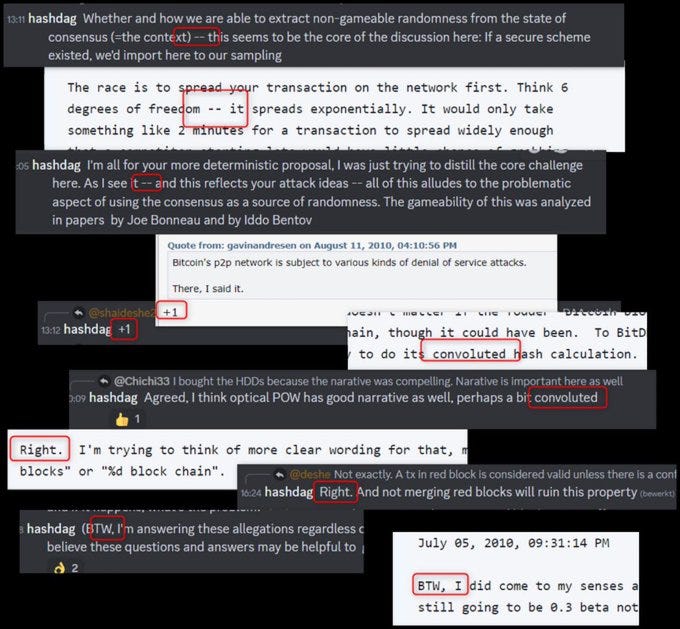
It is also important to note that, according to 40 final-year students from The Aston University Centre for Forensic Linguistics, the Bitcoin Whitepaper was at the very least written partially by Nick Szabo. However, they state that the Bitcoin Whitepaper could of had several authors. Read more here.
21. Similar to what Satoshi did with calling the smallest denomination of Bitcoin a ‘Sat’. The smallest denomination of KAS is often referred to as a ‘Sompi’, although not everyone refers to it with this name.
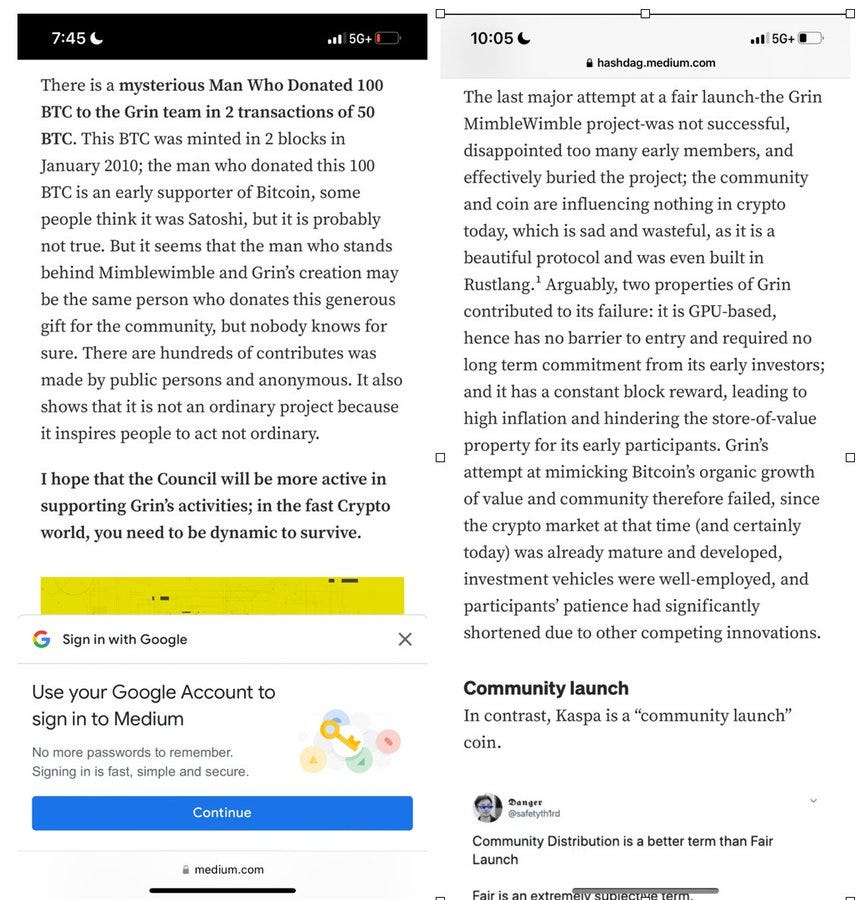
22. In November 2019, an anonymous donor contributed 50 BTC to the Grin General Fund, sparking a wave of speculation that the sender might be Satoshi Nakamoto—the elusive creator of Bitcoin. While the rumors gained traction, no conclusive evidence ever confirmed Satoshi’s involvement. What I find particularly interesting is that Yonatan wrote about this on his Medium account, though I can no longer locate the post. Did he remove it? I’ve seen him delete old tweets on X before, so I’ve included a screenshot of it below.
23. Yonatan Stated He Can Code
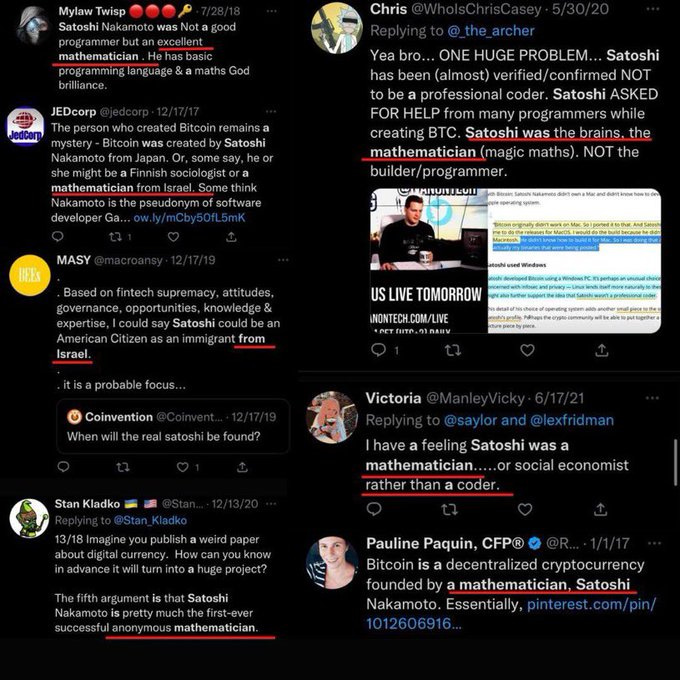
Although he says he got a low score, I’m more excited by the fact that he confirmed that he can code. There is no public code of his available that I have been able to find and I believe he has intentionally hidden all of his code so it cannot be analyzed. He could even be lying about getting a low score, but I doubt it as I could see him getting a low score and still being Satoshi. Just because someone scores a low grade doesn’t mean they don’t have the knowledge. He could of been busy with any number of things which distracted him.
A low score actually gives more credence to the theory that Satoshi wasn’t even a coder, but more of a mathematician, as some people have suggested.
24.
“I don’t know who Satoshi is and I can actually prove she’s not me” - Yonatan
Since the U.S. Government claims to have interviewed Satoshi in California and that there were four people involved in creating Bitcoin. ( Listen to the interview here ) Then Yonatan could be implying that he doesn’t know “Satoshi” as a single individual, because in this context, “Satoshi” refers to a group of four. He’s suggesting that he can prove one of the other three members isn’t him, which still leaves open the possibility that he is one-fourth of the Satoshi collective.
Unless Yonatan explicitly states, “I am not Satoshi, nor a member of the group known as Satoshi, and I had no role in creating Bitcoin,” or something equally clear and specific, I’m going to continue believing he could be one of the four—because there are just too many “coincidences.”
25. Who is Satoshi?

I can’t believe he actually said, “I don’t know that any of this matters.” He launched a coin around the same time he was hinting, joking, and even outright claiming to be Satoshi. That absolutely matters to investors—especially if he’s trying to commit fraud and get rich, as he’s stated before—because investors could suffer real harm. He’s clearly not stupid, so there must be more to this.
Possibility 1: He is Satoshi (or part of the group)
In this case, he is legally insulated because he’s not misrepresenting anything.
His cryptic tone could be a way of maintaining plausible deniability while still engaging with the mythos.
Possibility 2: He’s confident he won’t face consequences
That could stem from having strong legal counsel, powerful connections, or enough distance from direct fundraising to avoid fraud accusations.
If he never explicitly says “I am Satoshi” and doesn’t use that claim to solicit investment, he might believe he’s safe from legal scrutiny.
Either he is Satoshi or he’s fighting his cognitive dissonance by telling himself excuses as to why he wont face any consequences. This is yet another thing Yonatan has in common with Satoshi: neither were/are a philanthropic altruist! As Bitcoin’s origin story was cultivated—not innocent. They both are most likely just selfish, but this could also be part of a much bigger plan to get all the other countries to just give up their weapons…time will tell…
26.


I never watched this movie so I got no input, but if @p2p_nick is correct then that is pretty coincidental and I ask again: How many coincidences until something is no longer considered a coincidence?
There’s no universal threshold and sure it could just be apophenia, but when coincidences begin to form a consistent, predictive pattern, especially across unrelated domains, people start to question randomness. Whether it’s three, five, or ten—context, timing, and impact matter more than the count.
Connection to Citation [2]
The most compelling “geographic” clue in the Bitcoin Whitepaper is Citation [2]:
H. Massias, X.S. Avila, and J.-J. Quisquater, “Design of a secure timestamping service with minimal trust requirement,” In 20th Symposium on Information Theory in the Benelux, May 1999.
This is an obscure, print-only paper from a regional conference in Haasrode, Belgium. Unlike the other citations (Wei Dai or Haber/Stornetta), which were circulating in digital form on the Cypherpunk mailing lists, this specific paper was virtually inaccessible to anyone outside of the Benelux university library system until it was digitized much later (around 2020). Satoshi had access to a paper that was extremely difficult to obtain unless you were in the Benelux academic ecosystem.
The Sompolinsky Connection: Haim and Yonatan
Haim Sompolinsky is a world-renowned physicist and a pioneer in Computational Neuroscience. His work centers on the statistical mechanics of neural networks—a field that shares deep mathematical DNA with the distributed consensus logic found in Bitcoin and later evolved in Yonatan’s work.
The Benelux Link: Haim was a frequent traveler in the elite European information theory and physics circuits during the late 90s and early 2000s. While no public record explicitly places him at the 1999 Haasrode symposium (an intimate event with only ~70 attendees), he held positions at institutions like Bell Labs and Harvard, giving him the “institutional credentials” to access restricted archives at KU Leuven or UCLouvain during his frequent European collaborations.
The Household Library: If Haim acquired the 1999 proceedings—either by attending or through a colleague at the COSIC lab—the physical book would have been in his private library. A young Yonatan Sompolinsky (who would have been roughly 18 in 2008) would have had access to this rare source material while developing the foundations of what would eventually become the GHOST protocol and Kaspa. He could of also attended the symposium in person with his dad.
The Intentional Trail: While investigators often point to Len Sassaman (who was physically at KU Leuven at the time) as the source of this citation, it is plausible that a “Group Satoshi” used such a specific, obscure reference to either pay homage to their source material or to leave a trail that pointed toward the Belgian cryptographic community.
Here is the deeper, more subtle technical trail:
The “Recursive Indexing” Connection (Merkle/Haber)
In section 7 of the whitepaper (Reclaiming Disk Space), Satoshi cites Ralph Merkle [7].
The Clue: Satoshi describes a method for pruning the tree to save space.
The Sompolinsky Link: One of Haim Sompolinsky’s most famous contributions to physics and neuroscience is the study of information storage in recurrent neural networks.
The Coincidence: Yonatan’s PhD work at the Hebrew University wasn’t just about “money”—it was specifically about the efficiency of information propagation and storage in distributed graphs. Satoshi’s obsession with disk space and Merkle trees is a “Practical Engineer” problem that mirrors the “Information Entropy” problems Haim spent his life solving.
The “Poisson Process” DNA
Satoshi’s whitepaper is built on the Poisson Distribution (see Section 11, Calculations).
The Math: To prove that an attacker can never catch up, Satoshi uses a Poisson process to calculate the probability of a “Gambler’s Ruin.”
The Family Business: Poisson processes and stochastic modeling are the bread and butter of Haim Sompolinsky’s work in physics. Most physicists understand Poisson modeling, but Yonatan’s GHOST and PHANTOM papers use highly advanced stochastic geometry to prove the security of DAGs.
The “Father-Son” Bridge: It is as if the “Satoshi” who wrote the whitepaper had a mastery of Introductory Stochastic Physics, and the “Yonatan” who wrote GHOSTDAG had the Advanced version of that same mathematical toolkit.
Yonatan formalized what Satoshi hinted at. The Bitcoin Whitepaper uses a continuous-time stochastic model instead of classical distributed systems proofs which is unusual relative to 2008-era CS papers. And Yonatan Sompolinsky’s later work (GHOST / PHANTOM) lives very naturally in that same probabilistic framework. So the connection is: “Same mathematical language, same worldview about how consensus should be modeled.” Either Yonatan is Satoshi or he is just one of the people most capable of extending Bitcoin’s ideas.
We have narrowed the search to the “Ecosystem of Origin.” We can say with high confidence that:
Satoshi was a “Physicist-Coder” from the Information Theory school.
Satoshi had access to a rare 1999 Belgian research silo.
Satoshi’s mental model was Stochastic/Poisson, not classical CS.
To Conclude
I’ve come across some compelling cases suggesting others could be Satoshi. But in the end, each one hits a dead end—ultimately disqualifying them. Only a small group remains, and within that group, the most likely candidates that make up the group known as “Satoshi Nakamoto” are Nick Szabo, Hal Finney, Gavin Andresen, and Yonatan Sompolinsky. That’s assuming, of course, the U.S. government isn’t lying when they claim to have met Satoshi—alongside three other individuals.
To be clear, I am not the one that made this connection. I found the original information on this twitter thread. I will continue adding new evidence as I find it.
Disclaimer: This article is purely my personal opinion and exercise of free speech. This is unequivocally NOT financial advice, investment advice, OR a recommendation to buy, sell, or hold ANY asset. You are fully responsible for your own financial decisions. Nothing herein guarantees any outcome. Cryptocurrencies are volatile and you can lose your entire investment. Always do your own research before making any investment decisions.