
The 4-Year Cycle Is Changing, And That May Be the Most Bullish Signal Crypto Has Ever Produced
Bitcoin's maturation into a macro asset, driven by ETFs and institutional adoption, signals a shift from reflexive boom-bust cycles to a longer-term cycle.

This article is a follow-up to my earlier piece, The Impending Alt Season and What to Expect, where I was trying to narrow down where the Bitcoin cycle top might occur and how alt season would likely follow it. At the time, the working assumption was still that the traditional 4-year cycle would hold together in some recognizable form: Bitcoin would lead, dominance would peak, capital would rotate into altcoins, and the cycle would eventually end with some version of the classic blow-off top. That was the model because that was what history suggested. Previous cycles were messy in real time, but the halving-anchored structure broadly held together.

The problem is that this cycle no longer fits that structure. At some point, “delayed” stops being an explanation and becomes denial. Bitcoin did peak inside the historically expected post-halving timing band, topping around October 2025 near $126K. But almost none of the surrounding market structure behaved the way prior cycles did. Dominance never truly collapsed, alt season never arrived in the classic broad-market form, and the post-ATH behavior looked far more compressed and structurally stable than previous bear markets. This cycle didn’t produce the same results because the rest of the historical pattern stopped behaving normally around it.
The Ultimatum: Crypto Either Fizzles Out or Explodes
I do not think the 4-year cycle changing is automatically bearish. I think it may be the opposite. Once a technology reaches meaningful global adoption, especially near the 10–15% range where diffusion often begins accelerating beyond early adopters, it usually faces an ultimatum. It either fails because the underlying system cannot survive real-world pressure, or it becomes embedded deeply enough into society that adoption becomes structural rather than speculative. Rogers’ diffusion model describes adoption as a staged process moving from innovators and early adopters into broader mainstream groups, and Moore’s “chasm” framing is built around the same core problem: technologies must cross from enthusiast adoption into mainstream adoption or stall out (Moore, 2014; Rogers, 2003).

That is why crypto’s current position is so important. Bitcoin is not a fad anymore. It is not a meme that can simply disappear quietly. Bitcoin now has global liquidity, institutional custody, ETF access, regulatory pathways in major markets, sovereign-level discussion, scarcity mechanics, and one of the strongest network effects in finance. The approval and growth of U.S. spot Bitcoin ETFs changed access to Bitcoin in a way no previous cycle had. BlackRock’s iShares Bitcoin Trust became the world’s largest Bitcoin fund within months of launch, reaching nearly $20 billion in assets by May 2024, according to Reuters (Siddiqui, 2024). That is not the profile of a technology slowly fading into irrelevance.
How and Where the 4-Year Cycle Changed
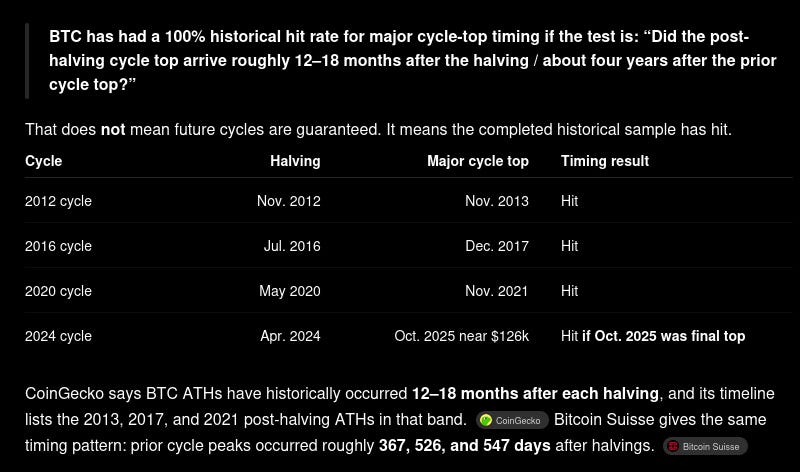
Historically, Bitcoin’s major cycle peaks aligned surprisingly well with the halving schedule. The 2013 cycle peaked roughly 370 days after the 2012 halving. The 2017 cycle peaked roughly 525 days after the 2016 halving. The 2021 cycle peaked roughly 550 days after the 2020 halving. CoinGecko summarizes the broader historical pattern as Bitcoin all-time highs generally occurring roughly 12–18 months after halvings (Lim, 2026).
This cycle initially appeared to fit that model. The April 2024 halving implied a historically normal peak window somewhere around mid-to-late 2025, and Bitcoin ultimately peaked near October 2025 around $126K. So if you only looked at Bitcoin itself, you could argue the cycle still technically respected the historical timing structure, but the surrounding market behavior certainly did not.

In prior cycles, Bitcoin peaking was only one part of a larger reflexive process. Dominance eventually rolled over, retail speculation exploded outward into altcoins, broad-market mania intensified, and the market finished with a clear euphoric expansion phase. This time, that structure largely failed to materialize. Bitcoin dominance remained unusually elevated, the classic broad alt season never fully arrived, and the market transitioned into a much more muted post-ATH environment than previous cycles.
Even the bear market behavior changed as previous Bitcoin cycle tops were followed by violent collapses and extreme reflexive unwinds. This time, despite meaningful downside and volatility, the overall market structure remained comparatively stable relative to prior post-peak environments. Corrections looked shallower so far (this cycle’s ~50% drawdown vs. historical 75-85% drops), institutional demand remained persistent, and the market increasingly behaved like an emerging macro asset rather than a purely speculative retail mania cycle.

That is the real structural break, and the issue is not that Bitcoin failed to rally. The issue is that the broader 4-year reflexive cycle dynamics stopped functioning normally around Bitcoin itself.
Past Cycles Felt Changed But This One Is Changed
Here’s the distinction:
Past cycles (2013, 2017, 2021):
Looked messy in real time
But the halving‑anchored structure held
And the timing bands matched
And alt season arrived (2013 was an early altcoin wave)
And dominance collapsed (except for 2013)
This cycle (2025–2026):
The structure is failing during the cycle
Dominance didn’t collapse
Alt season didn’t happen
Halving didn’t trigger classic broad-market expansion
Macro + ETFs overwhelmed the old model

This is not the same thing, and the ETF system is probably the biggest reason why. Previous cycles were mostly crypto-native reflexive loops driven by retail speculation, leverage, internal capital rotation, and momentum psychology. This cycle introduced persistent institutional capital pipelines directly into Bitcoin itself. BlackRock describes IBIT as a standard ETF vehicle providing familiar Bitcoin exposure through traditional financial rails (BlackRock, n.d.). That fundamentally changes how capital flows through the ecosystem.
A pension fund allocating into Bitcoin through IBIT does not necessarily rotate profits into mid-cap altcoins afterward. A sovereign wealth fund is not likely to ape into speculative meme assets after Bitcoin rallies. The old model depended heavily on internal crypto-native capital rotation. The new model increasingly depends on external institutional demand entering Bitcoin directly and often remaining there. That alone can change the old cycle mechanics.
The halving’s relative influence also appears weaker than before. Bitcoin’s April 2024 halving still mechanically reduced issuance from 6.25 BTC to 3.125 BTC per block. But Bitcoin is now large enough that ETF inflows, macro liquidity, and institutional allocation can dominate the market structure far more than the supply shock itself. Earlier cycles were primarily supply-shock driven. This one increasingly appears demand-structure driven.

That is why this cycle feels so strange. Bitcoin itself still respected the historical timing window, but dominance behavior changed and alt season weakened dramatically. Post-ATH volatility compressed and institutional flows overwhelmed reflexive crypto-native rotation. The market structure evolved while the old cycle model remained mostly frozen in place. The result is a cycle that superficially resembles prior ones on the surface while behaving fundamentally differently underneath.
The Longest Sustained Growth Phase for Disruptive Tech Is Often 16–20 Years
Modern disruptive technologies often move through their strongest adoption phase inside a 16–20 year window or less. Comin and Mestieri’s technology-diffusion data show that modern adoption lags compressed dramatically, reaching about 16 years for personal computers and 7 years for the internet, while Christensen’s S-curve framework explains why mature technologies eventually flatten and become vulnerable to replacement by newer technologies that solve the incumbent’s limitations (Comin & Mestieri, 2018; Christensen, 1992).
One reason this matters is because crypto may still be early in its broader adoption lifecycle. Disruptive technologies often spend years looking speculative and unstable before transitioning into mainstream infrastructure. Rogers’ diffusion model places mass adoption after the early adopter phase, while Moore emphasizes the difficulty of transitioning from enthusiasts into mainstream users (Moore, 2014; Rogers, 2003).
Crypto is roughly 17 years into Bitcoin’s lifecycle, depending on whether you measure from the network launch, early trading, or broader market awareness. That places it directly inside the historical window where disruptive technologies often transition from speculative growth into structural integration.

Crypto is no longer early enough to be ignored, but still early enough to compound aggressively if structural adoption continues. That is exactly the kind of environment where old reflexive boom-bust models begin weakening as long-duration institutional and infrastructure-driven capital starts dominating market behavior.
What a Supercycle Actually Is
A supercycle isn’t “infinite up.”

It’s a macro‑driven, longer, slower expansion where:
Halvings matter less
Institutions dominate flows
Corrections are shallower
Tops are less blow‑off and more distribution
Alt season becomes irregular or nonexistent
Dominance patterns break
This cycle fits that profile.
A textbook supercycle setup happens when a technology or asset crosses the mass‑adoption threshold (around 10–15% global penetration) and demand becomes structural instead of speculative. At that point, growth stops being driven by early adopters and starts being driven by institutions, governments, and mainstream users. This creates a persistent demand shock that supply cannot expand to meet, producing long, shallow corrections and multi‑year expansions instead of the sharp boom‑bust rhythm of normal cycles. You can explore this dynamic with mass adoption effects.
A supercycle also requires macro alignment and reflexivity: falling or stable interest rates, expanding global liquidity, and a narrative the world believes (“this technology is inevitable”). When higher prices attract more adoption, and more adoption drives higher prices, you get a self‑reinforcing loop. Add institutional entrenchment with pension funds, sovereign wealth funds, corporate treasuries, and the market transitions from cyclical to secular. This is why supercycles last many years and only end when the underlying technology either fails catastrophically or fully matures.

A Transition From the 4-Year Cycle to a Supercycle Structure
This is also why I think the changing of the old 4-year structure may actually be bullish rather than bearish. If the old cycle failed because Bitcoin lost relevance, that would be deeply bearish, but that is not what happened. The structure broke while Bitcoin gained ETF access, institutional legitimacy, sovereign discussion, regulatory clarity, and deeper integration into global finance. That looks less like collapse and more like maturation.
The market now appears caught between two different regimes at once. Bitcoin itself still retains traces of the historical halving structure, but the surrounding reflexive dynamics increasingly resemble a structurally integrating macro asset. The result is a hybrid market that no longer behaves cleanly like the old crypto-native boom-bust cycles.
That also explains why the post-ATH drawdown feels different from prior ones. Previous post-ATH environments were violent reflexive unwinds driven largely by leverage collapse and speculative exhaustion. This cycle’s post-peak structure appears comparatively compressed and stable because institutional demand and ETF infrastructure create persistent baseline buying pressure that did not exist before.
To Be Blunt
I was wrong about an impending alt-season and now it is time to re-evaluate. Since the 4-year cycle has held up timing-wise so far, prior cycle timing would point toward a possible bear bottom around Oct–Nov 2026. The question now is:
Will the pattern continue to hold, or will we see more changes?
Also, if Bitcoin is moving toward a supercycle, that may be exactly when another network starts to decouple from Bitcoin. A Bitcoin supercycle would not necessarily mean the entire crypto market moves together forever. It could mean Bitcoin becomes the institutional reserve asset while a separate network, with different utility, throughput, or monetary dynamics, begins forming its own independent adoption curve. In that kind of environment, the next major opportunity may not look like a traditional alt season. It may look more like selective decoupling. Which leaves another question I keep pondering:
Will Kaspa decouple from Bitcoin in the months or years ahead?
In my prior article, The Reflexive Flip: Kaspa’s Window of Disruption, I argued that disruption has to happen before reflexivity fully takes over. If Kaspa waits until after Bitcoin’s next reflexive rotation is already mature, then Kaspa risks being absorbed into the same system it was meant to challenge: another high-beta asset riding Bitcoin’s liquidity cycle instead of forming its own independent monetary narrative.
That is why the timing still matters. Kaspa has already shown higher velocity than age-matched Bitcoin. The question now is whether it can maintain that lead. Based on the historical age-matched comparison between Bitcoin and Kaspa from their respective launches, Kaspa would need to reach roughly $0.36 by September 2026 to merely match Bitcoin’s equivalent point in its lifecycle. I built a velocity tracking website at https://kaskold.com/kascan to monitor that comparison directly. Missing that level would not automatically disqualify the thesis, but staying ahead of Bitcoin’s age-matched velocity curve would be a massive signal that the market is still treating Kaspa as something structurally different.
The old article leaned toward a possible convergence window around the beginning of 2027, and I am still hopeful that framework plays out. If Bitcoin’s cycle remains intact time-wise but continues changing structurally, then the question is not simply whether alt season arrives. The deeper question is whether one network can separate from Bitcoin’s gravity before the market fully prices in the new regime.
That would not look like a normal altcoin rotation. It would look like a reflexive rupture: Bitcoin becoming the institutional reserve layer, while Kaspa attempts to prove that a faster, high-throughput proof-of-work network can build its own adoption curve, miner economics, and monetary premium. In that sense, Kaspa may already be decoupling subtly through velocity. The question is whether that early velocity decoupling can survive long enough to become visible in price, dominance, usage, exchange access, fee-market development, and narrative crossover.
Summary
This does not mean crypto cannot crash again. It absolutely can, but the structural behavior is changing. The simplest explanation is no longer that the old cycle is merely delayed. The simplest explanation is that the original 4-year reflexive structure changed because the market itself evolved beyond the conditions that originally created it.
In short:
I was wrong about the classic alt-season sequence, and “delayed” is no longer a strong enough explanation.
The structural signals show the 4-year cycle is changing.
If October 2025 was the final cycle top, the 4-year cycle is intact time-wise, but any new ATH from here would push the cycle outside the normal 4-year timing structure.
The biggest structural change is that ETFs and institutional flows are pulling capital directly into Bitcoin instead of forcing the old crypto-native rotation outward into altcoins.
Crypto appears to be approaching the adoption zone where supercycle dynamics become plausible, especially in major markets where ownership is already near or above early-mainstream levels.
Kaspa flipping Bitcoin remains plausible, but only if early velocity becomes durable structural adoption.
The 4-year cycle is changing, but crypto itself may be entering something much larger.
References
BlackRock. (n.d.). iShares Bitcoin Trust ETF. https://www.blackrock.com/us/financial-professionals/investments/products/bitcoin-investing
Chainalysis. (2025, September 2). The 2025 Global Crypto Adoption Index: India and the United States lead cryptocurrency adoption. https://www.chainalysis.com/blog/2025-global-crypto-adoption-index/
Christensen, C. M. (1992). Exploring the limits of the technology S-curve. Part I: Component technologies. Production and Operations Management, 1(4), 334–357. https://doi.org/10.1111/j.1937-5956.1992.tb00001.x
Comin, D., & Mestieri, M. (2018). If technology has arrived everywhere, why has income diverged? American Economic Journal: Macroeconomics, 10(3), 137–178. https://doi.org/10.1257/mac.20150175
Lim, Y. (2026, April 17). Is the top in? Bitcoin peaks 68 days earlier than last cycle. CoinGecko. https://www.coingecko.com/research/publications/when-bitcoin-all-time-highs
Moore, G. A. (2014). Crossing the chasm (3rd ed.). HarperBusiness.
Rogers, E. M. (2003). Diffusion of innovations (5th ed.). Free Press.
Siddiqui, Z. (2024, May 29). BlackRock’s ETF becomes largest bitcoin fund in world, Bloomberg News reports. Reuters. https://www.reuters.com/technology/blackrocks-etf-becomes-largest-bitcoin-fund-world-bloomberg-news-reports-2024-05-29/
Triple-A. (2024). Global crypto ownership: How many people own cryptocurrency? https://www.triple-a.io/cryptocurrency-ownership-data