
Bitcoin’s Blind Spots: The Whitepaper Wasn’t Perfect
Was the whitepaper a rushed draft, stylometric decoy, or a testbed for decentralization?
The quirks and anomalies in the Bitcoin whitepaper may not just be sloppy drafting. They could be deliberate signals of multiple authorship, misdirection to mimic Nick Szabo’s style, or evidence that Satoshi was less experienced than legend suggests.
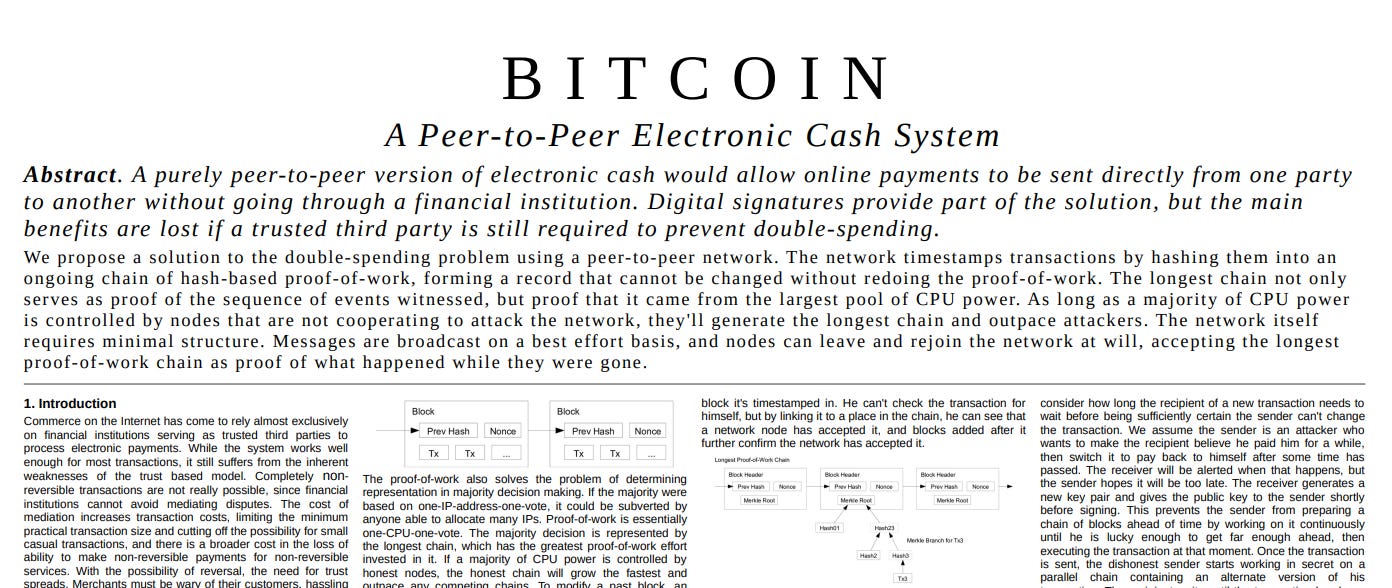
Bitcoin Whitepaper’s Quirks and Anomalies
The Bitcoin whitepaper is revered, but a close read reveals a patchwork of oddities:
Typographical inconsistencies: Written in OpenOffice/Word but mimicking LaTeX, resulting in awkward spacing, ASCII diagrams, and straight quotes.
Typos and concatenations: “proofof-work” appears without spacing; similar run-ons occur elsewhere.
Mixed spellings: British “favour” alongside American “realizes,” suggesting either multiple authors or deliberate obfuscation.
Code quirks: Section 11’s C snippet initializes
sumoddly, risking precision issues. The actual Bitcoin client was in C++, making the example feel out of place.Terminology shifts: “Nodes” are treated as miners, though in practice not all nodes mine.
Stylistic anomalies: Frequent use of “we” implies a team, despite the pseudonym. Awkward phrasing like “constant of amount” betrays non-native polish.
Metadata oddities: A GMX email (German provider) and a website registered after release add to the mystery.
Conceptual omissions: Merkle pruning is oversimplified; the Poisson model ignores real-world network variance.
These quirks make the paper feel raw and rushed, which seems to me, like either a deliberate disguise or the product of someone less academically polished than assumed. Then again, it could simply reflect multiple authors from vastly different regions.
Multiple Authors or Deliberate Misdirection?
Stylometric studies have found overlaps with Nick Szabo’s writing. If Satoshi wanted credibility, mimicking Szabo’s style would be clever camouflage. Alternatively, if Satoshi was less educated, he may have leaned on Szabo’s phrasing to give the paper gravitas. The use of “we,” mixed spellings, and uneven technical depth all point to either multiple contributors or intentional misdirection.
Logic Fork: Who Wrote the Bitcoin Whitepaper?
A. Solo Author Hypotheses
A1. Stylometric Camouflage
Satoshi deliberately mimicked Szabo’s style to gain credibility or seed confusion.
Mixed spellings, “we” phrasing, and uneven depth were inserted to thwart stylometric analysis.
Anonymity was engineered, not incidental.
A2. Patchwork Skillset with Peer Influence
Satoshi was a solo author with uneven strengths—strong in cryptography, weaker in writing or economics.
Borrowed phrasing and terminology from Szabo or mailing list discussions to sound credible.
ESL or non-academic background may explain grammar quirks.
Stylometric overlaps are incidental, not strategic.
B. Multi-Author Hypotheses
B1. Collaborative Drafting with Final Solo Edit
Multiple contributors shaped early drafts; one person finalized and published it.
Explains “we,” mixed depth, and stylometric blend—but rare in high-stakes launches.
B2. Coordinated Misdirection
A group deliberately inserted stylometric noise and inconsistencies to obscure authorship.
Used “we,” mixed spellings, and uneven depth as camouflage.
Anonymity was a design goal, not a side effect.
B3. Multiple Amateurs (Highly Unlikely)
A group of non-experts collaborated informally.
Style inconsistencies reflect lack of polish.
Contradicted by the paper’s technical rigor and protocol resilience.

Conclusion
The Bitcoin whitepaper’s quirks may be fingerprints of multiple authorship, deliberate misdirection, or simply the marks of a less polished creator. Whether camouflage or coincidence, the inconsistencies blur the line between precision and disguise.
If intentional, they reveal a mind fluent in both code and misdirection. If accidental, they humanize Satoshi as less a flawless genius, and more a determined builder refining a radical idea. Either way, the imperfections are part of the myth, reminding us that even a system built for transparency was born from deliberate opacity.

Disclaimer: This article is purely my personal opinion and exercise of free speech. This is unequivocally NOT financial advice, investment advice, OR a recommendation to buy, sell, or hold ANY asset. You are fully responsible for your own financial decisions. Nothing herein guarantees any outcome. Cryptocurrencies are volatile and you can lose your entire investment. Always do your own research before making any investment decisions.